Why is Linkedin personal branding becoming essential?

For years, many business owners and decision makers viewed LinkedIn as little more than an online CV - originally it was the ‘recruiters’ platform where you were hunted out for, or searched for, that perfect job. A place to update your job title, connect with a few people and perhaps post the occasional company update.

But, the way we buy has changed. Buyers are researching differently. Prospects are forming opinions before they even click on your website. Potential employees are evaluating leadership teams before applying for roles. Partners, suppliers and investors are all making judgements based on what they find online.Increasingly, people want to know who is behind the business.And that is exactly why building a personal branding on LinkedIn has become so important. Because visibility builds trust.

People buy from people (no matter how cliche that sounds)

Whether you're running a manufacturing company, engineering business, consultancy, technology firm or professional service, your customers are still making decisions based on trust.

They want confidence that you understand their challenges.They want reassurance that you've solved similar problems before.They want to know your business is credible, experienced and capable.

The challenge is that trust used to be built almost exclusively through face-to-face interactions -  trade shows, networking events, sales meetings and trusty referrals.

Of course, those channels still matter, but they are no longer the only places where trust is formed. 

Trust often begins online, it’s accessible 24/7, we don’t need to be in the office (or on office hours) to research.

So it’s very likely that before a prospect has even booked a meeting, they may have visited your website, looked at your LinkedIn profile, viewed your content and researched your company.

In many cases, they have already formed an opinion before you even know they exist.

Your buyers are watching before they enquire

One of the biggest misconceptions about LinkedIn is that nobody is really bothered about what is said.

Heads of businesses often tell us, ‘my customers aren't on LinkedIn’ or ‘I don't have anything interesting to say’.

The reality is very different.

Many decision-makers rarely post
Many never comment.
Most don't engage publicly at all.

But they are reading.

They're consuming content.
They're researching suppliers.
They're checking profiles.

They're also assessing who appears knowledgeable, credible and trustworthy.

This is particularly important for those industries with longer sales cycles.

In manufacturing, engineering and technical sectors, buyers often spend weeks or months researching potential suppliers before making contact.

If your competitors are consistently appearing in their feed while your business remains invisible, who do you think they'll remember when the time comes to have a conversation?

You have more content than you think

One of the biggest barriers to personal branding is the belief that you need endless content ideas. Most business owners assume they have nothing worth talking about but the opposite is usually true.

I advise clients to think about the conversations you’re having every week, the questions customers ask, problems that your team solve, industry news, lessons learnt in your career, the wins, the losses…there’s heaps of content opportunities just living  in your head. 

What feels obvious, or disinteresting, to you is often incredibly useful to someone else. People want opinions, insights, experiences…they want a story. The expertise you've developed over years in your industry is exactly what potential customers want to learn from.

Consistent will always beat perfect

Many people approach LinkedIn with an all-or-nothing mindset, and I’ve been guilty of it myself.

Posting every single day for two weeks, get busy, then disappear into the sunset only to come back and start again - repeating over and over.

Because my clients always come first, so their work is prioritised. But when does that get detrimental to growing our own businesses? It’s the same with you and your clients. That visibility (or invisibility in my hiatuses) starts to compound over time.

Rarely is anything built - or sold - in one post but it is built through consistently being seen. Show up regularly.Share useful insights.Demonstrate expertise.

Continue to be seen long after everyone else has stopped or gone on their cyclical break, only to pop up 3 months later!

Personal branding supports more than sales

Many think that LinkedIn personal branding is only about generating enquiries. Whilst it does of course support business development, the benefits often extend further.

A strong personal brand can help:
- Attract better talent
- Support recruitment efforts
- Strengthen customer relationships
- Increase referral opportunities
- Open speaking opportunities
- Create partnership conversations
- Improve credibility during sales processes
- Position your business as an industry authority

In many cases, prospects arrive at sales conversations already familiar with your business because they've been following your content for months.

That means instead of starting from zero, you're building on existing trust.

The goal isn't more followers

The goal isn't becoming famous or collecting likes. It’s much simpler. 

By building a personal brand you want to become known for what you want to be known for.

To stay visible to the people who matter, to build trust before conversations begin and to create a digital presence that reflects the expertise you've spent years developing.

Because whether you like it or not, people are researching, comparing and evaluating.

If you think about your current profile set up, will viewers find a visible, credible expert or an empty profile that tells them very little and leaves them no option but to scroll by?

Your personal brand is no longer separate from your business brand, for many of your ideal prospects it is your business brand.

People want to know who they're buying from, who they're partnering with and who they're trusting with their investment.

LinkedIn gives business owners and senior decision makers an opportunity to build that trust at scale by consistently sharing valuable insights, expertise and experience.

The businesses that understand this are building relationships long before enquiries arrive, and in increasingly competitive markets, that consistent visibility can become one of the most valuable assets your business owns.

Our 'done for you' Linkedin package helps founders, directors and industry experts turn their knowledge into consistent visibility, authority and trust - without spending hours creating content themselves. You can book a conversation to find out more here.

Why do so many websites miss the point?

Most businesses don’t wake up one morning desperate for a shiny new website.

Usually, it starts with frustration - the enquiries have slowed down.

The business has evolved but the website still talks like it’s 2019. The messaging feels clunky. Competitors that you were never worried about before, suddenly look sharper.

Internally, everyone’s avoiding sending people to the homepage because it just doesn’t represent the business anymore and the conversation starts, 'We need a new website'.

Sometimes you do, but in my experience a lot of website redesigns focus far too much on making things look prettier but nowhere near enough on making them work better.

I'll be straight here - a new font, some animations and a slick video won’t magically fix confusing messaging, poor positioning or a website that leaves visitors wondering what you actually do.

The website itself often isn’t the real problem - clarity is. Most websites try to say too much; too many services, too many menu options, too much jargon and often, too many internal opinions stitched together over the years.

The end result usually means the customer lands on the site and has absolutely no idea where they’re meant to go next.

You’ve only got a few seconds to explain what you do, who you help, and why it matters to them. If that’s not obvious quickly, people leave.
That’s why we use a lot of StoryBrand thinking when approaching website projects, so many businesses say 'we’ve been established since...', 'we’re industry leaders…', 'we’re passionate about…' but your customer doesn’t care about your history - yet.

They care about whether you understand their problem. Your website should make the customer feel seen, understood and reassured that they’re in the right place. You’re there to show them (or guide them to use StoryBrand terminology) that you solve something frustrating, expensive, stressful or time-consuming.

A good redesign isn’t really about design first, it’s about positioning. It’s about understanding: who you actually want to attract, what they’re struggling with, what questions they have before enquiring, and what’s currently stopping them from taking action. Then building the website around that - not around what the internal team thinks 'sounds good'.

Clear headlines, simple navigation, obvious calls to action, proof points, testimonials, useful resources, and content that answers questions instead of just filling space. So before you jump into the fun bits, think about:

- What's this website supposed to do?
- Are you trying to generate more enquiries or just modernise the brand?
- Who are you trying to attract now? Has your audience changed?
- What makes us different from competitors?
- What questions do customers always ask before buying?
- What pages are people actually visiting?
- Are we giving visitors a clear next step?

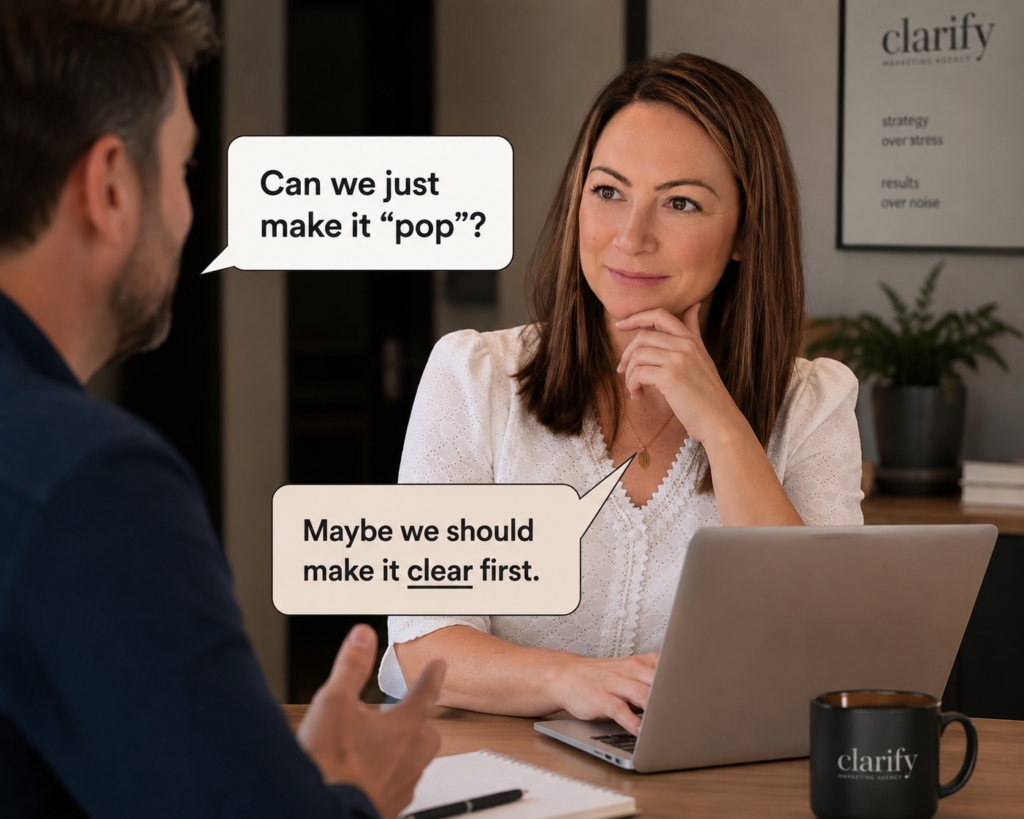
The answers to those questions shape a far better website than 'can we make the buttons more modern?' or 'can we make the text just pop'?

The best websites are the clearest. The ones that explain things properly. That remove confusion. That make it easy for someone to take the next step.

That’s usually what drives results - not the fancy animations and the text that 'pops'.