For decades, trade shows have been one of the most effective marketing channels available to manufacturing businesses.
In many sectors, they still are.
Walk around any major industry exhibition and you'll find decision makers, engineers, buyers, technical specialists and business owners all gathered under one roof. Deals are discussed. Relationships are built. New products are launched. Existing customers are strengthened.
For many manufacturing companies, trade shows have generated opportunities for years.
The problem isn't that trade shows no longer work.
The problem is when they become the entire marketing strategy.
Because while trade shows remain valuable, the way buyers discover suppliers, research solutions and shortlist vendors has changed dramatically.
And businesses that fail to recognise that shift are putting themselves at risk.
Trade shows still matter
Let's be clear - this post isn't about saying trade shows are dead. Far from it.
In some industries and regions, trade shows remain one of the most important routes to market.
Many manufacturing businesses still rely heavily on face-to-face relationships. Buyers want to see equipment, meet suppliers, ask technical questions and build confidence before making significant investment decisions.
The issue isn't attending trade shows.The issue is relying on them exclusively.
the buyer journey has changed
One of the biggest shifts in the manufacturing sector over the last decade isn't the products being sold. It's the way buyers buy.
Research suggests many B2B buyers are completing a significant portion of their research before they ever even speak to a supplier.
By the time they make contact, they've often already compared options, reviewed websites, consumed technical content and formed initial opinions about potential suppliers they'd like to shortlist - or work with.
If that research is correct, then your exhibition stand is no longer the first interaction a prospect has with your business - it may simply be the point where an existing impression is confirmed, or even challenged.
That's why visibility before, during and after an event matters far more than it ever used to.
Buyers no longer start their journey at the expo
Historically, a trade show might have been the first time a prospect encountered your company. Today, that is often no longer the case.
Many buyers begin researching suppliers long before they attend an event.
They are:
- Searching Google
- Reading technical content
- Browsing supplier websites + comparing you to competitors
- Watching videos
- Following industry discussions
- Reading case studies
So, by the time they walk onto a trade show floor, they likely already have a shortlist in mind. They already know which companies they want to make a beeline to visit. They're not wandering aimlessly waiting for you to 'lure' them onto your stand.
The expo is no longer the start of the buying journey, it's just one touchpoint within it.
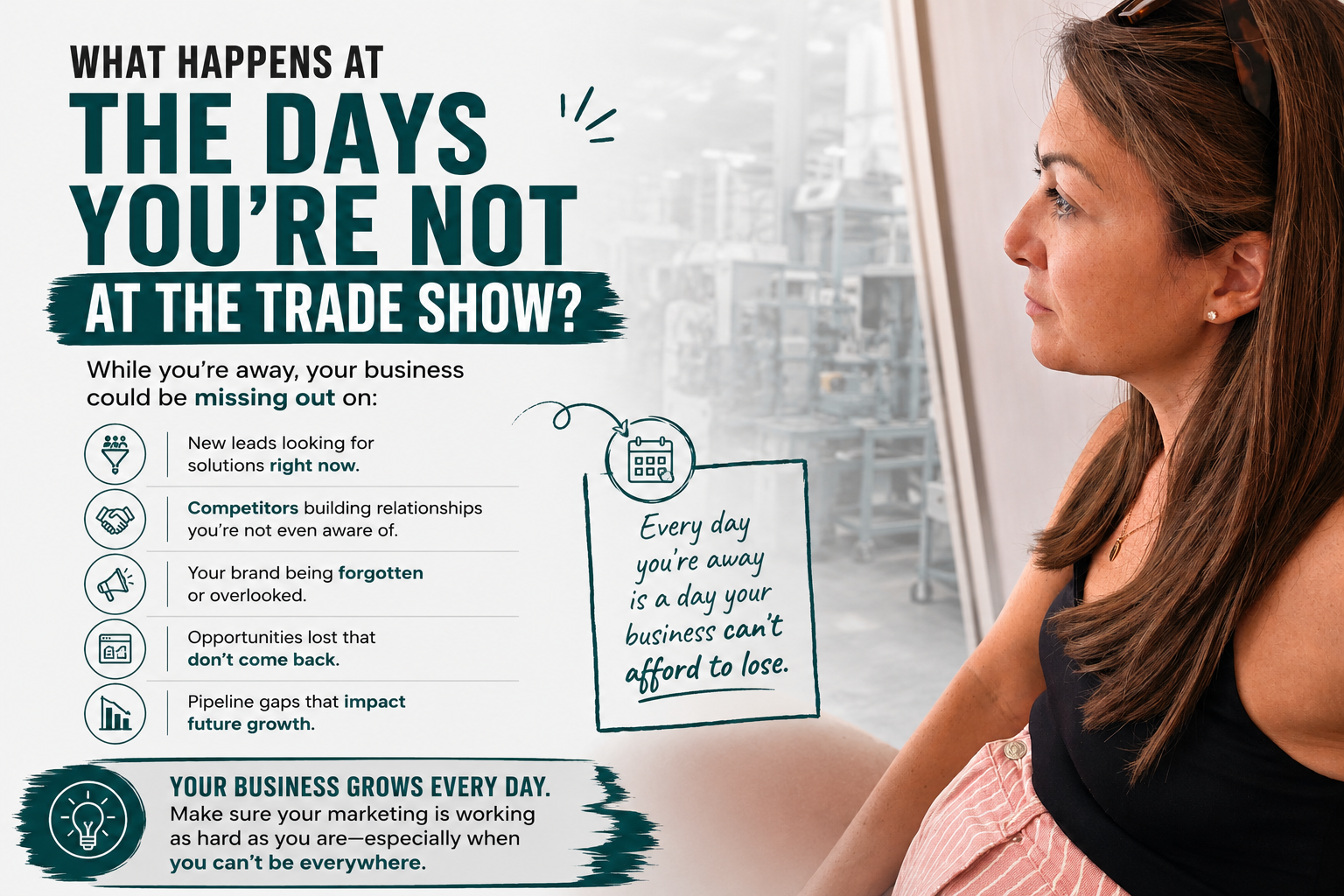
WHAT HAPPENS AFTER THE SHOW?
Many manufacturing businesses invest significant time and budget into exhibitions.
- The stand looks great.
- The team is there.
- Great conversations happen.
- Business cards are taken and given.
....then everyone goes back to normal.
That's often where the marketing stops.
We still see businesses whose annual marketing plan looks something like this:
- Attend three exhibitions
- Update stand graphics
- Print new brochures
- Send one email afterwards
The problem isn't the exhibition itself - it's the very little that happens during the other 350 days of the year.
Meanwhile, competitors are continuing to educate the market, share expertise, publish content, nurture prospects and build their visibility.
The exhibition created the opportunity -but the follow-up determines whether it turns into revenue.
are you putting all your budget into one channel?
Many businesses spend a substantial percentage of their annual marketing budget on these exhibitions.
Stand space. Logistics for machinery. Staff travel + accommodation. Graphics. Promo items. Customer entertainment.
The investment can be significant and if the event performs well, the return can be excellent.
But concentrating so much activity into a single event can create risk.
What happens if visitor numbers are lower than expected? Key prospects don't attend? Your competitors dominate the conversation? Economic uncertainty reduces attendance?
When the majority of your marketing investment sits within a handful of annual events, performance becomes heavily dependent on factors outside your control.
MORE THAN A SINGLE CONVERSATION
Manufacturing sales cycles are rarely quick. Most buying decisions involve multiple stakeholders.
One conversation at a trade show rarely closes a deal. What often happens is a prospect visits your stand; they have a positive conversation, they take a brochure and a business card and a promise to get in touch...then they return to work.
And that's where many marketing strategies end.
The companies generating the strongest results are the ones that continue the conversation after the event.
They support prospects with:
- Technical content
- Case studies
- Email nurture
- LinkedIn content
- Website resources
WHY DEMAND CAPTURE IS ESSENTIAL
A lot of businesses hear the phrase 'digital marketing' and immediately think social media.
But this isn't about posting more content, it's making sure interested buyers have somewhere to go next.
When somebody visits your stand, they may not be ready to buy immediately.
The strongest businesses create systems that capture and nurture demand long after the exhibition has finished.
That's where websites, LinkedIn, email nurture and technical content play such an important role.
They're not replacing trade shows, they're supporting them to go beyond the exhibition days.
tHE RISE OF HYBRID
One of the biggest shifts in manufacturing marketing is that buyer journeys are now more hybrid.
People move between online and offline channels constantly.
A prospect might discover you through LinkedIn, head to your website, read a case study or two, meet you at a trade show, download a guide, reach out to sales, visit your website again and then request a meeting or quote.
Trying to isolate a single channel as the source of success misses the bigger picture - the strongest marketing systems combine multiple touchpoints that work together.
Trade shows are still part of that journey but they're no longer the entire journey.
WHAT SHOULD MANUFACTURING BUSINESSES DO INSTEAD?
The answer isn't to replace trade shows, it's to make them work harder.
Before the event:
- Build awareness online
- Promote attendance
- Book meetings in advance
- Share educational content
During the event:
- Capture conversations properly
- Gather meaningful contact information
- Create content from the exhibition
After the event:
- Follow up consistently
- Share relevant resources
- Nurture prospects through email
- Stay visible through LinkedIn and digital channels
When trade shows are integrated into a wider marketing system, their value increases significantly.
ONE STEP IN THE JOURNEY
The most successful businesses aren't abandoning trade shows, they're selectively picking where the best ones will work for them - and their clients, and making them part of a wider system.
They use exhibitions to strengthen relationships, demonstrate products and have valuable face-to-face conversations.
But they also recognise that buyers are researching suppliers on websites, LinkedIn and technical publications long before they speak to sales.
The result is a marketing approach that combines brand visibility, technical credibility, demand generation, sales enablement and relationship building as a joined up approach - rather than relying on a single event to carry the entire year's marketing performance.
Trade shows still work and for many manufacturing businesses, they will remain one of the most valuable marketing investments available, but you need to be aware that buyer behaviour has changed.
Customers no longer rely solely on exhibitions to discover suppliers, compare solutions or build confidence.
The risk is not attending trade shows, but it is assuming that trade shows alone are enough. Companies seeing the strongest growth today are not choosing between one or the other, they're combining marketing activity - online and offline.
The companies that remain visible between events are often the companies buyers remember when it's finally time to make a decision.